
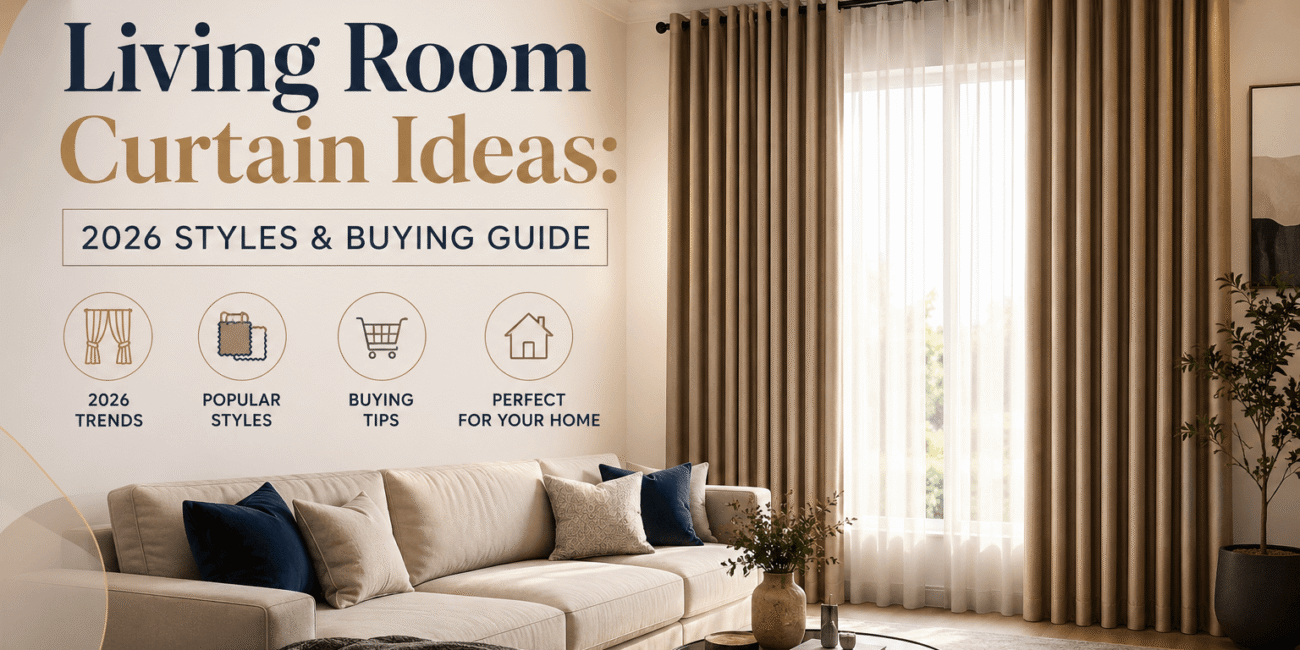
Curtains do more heavy lifting in a living room than most people realize. They frame your windows, soften hard architectural lines, control how much light spills in, and quietly tie your color palette together. Yet curtain shopping is often an afterthought, squeezed in after the sofa and rug have already been chosen.
This guide walks through practical living room curtain ideas, how to choose the right fabric and color, and the sizing details that make curtains look custom rather than store-bought. Whether you’re refreshing a rental or planning a full room, you’ll find design inspiration and real answers here not just a mood board.
If your living room already leans neutral and cozy, it’s worth pairing this guide with broader interior design tips for the room as a whole, since curtains work best when they support the rest of your decor rather than compete with it.
Best Living Room Curtain Ideas
Not every curtain style suits every room. Here are the approaches that consistently work well in living rooms, along with when to use each one.
1. Floor-Length Panels in Linen or Cotton Blends
Natural-fiber panels that puddle slightly or graze the floor bring a relaxed, layered look. Linen in particular filters light beautifully without blocking it entirely, which keeps a living room feeling open during the day.
2. Layered Sheers with Blackout Panels
Pairing a lightweight sheer with a heavier blackout curtain behind it gives you flexibility sheer during the day for privacy and diffused light, blackout drawn in the evening. This layered approach also adds visual depth to a plain window. For rooms that face harsh afternoon sun, dedicated blackout curtains are worth the investment on their own.
3. Bold Pattern as a Focal Point
If your sofa and walls are neutral, a patterned curtain (botanical, geometric, or an abstract print) can become the room’s signature moment without needing extra artwork.
4. Textured Solids
Boucle, velvet, and slubbed weaves add tactile interest even in a single color. Velvet in particular works well in living rooms because it also improves acoustics, softening echo in rooms with hard floors.
5. Café-Style or Half Panels
For living rooms with a view worth keeping, half-length panels or café curtains cover only the lower portion of the window, preserving privacy without sacrificing the outlook.
6. Wide, Multi-Panel Setups
Instead of a single pair of curtains, using three or four panels across a wide window (or a set of windows) creates a fuller, more tailored look than one thin pair stretched too far.
How to Choose Living Room Curtains
Knowing how to choose curtains for living room spaces comes down to five factors: light, privacy, fabric weight, color, and how the curtains relate to your existing furniture.
Start by asking what job the curtain needs to do:
- Do you need to block light? A south- or west-facing room that gets harsh afternoon sun benefits from a blackout or room-darkening liner.
- Is privacy a priority? Ground-floor living rooms facing the street usually need a sheer layer, even if the outer curtain is decorative.
- How much foot traffic is near the window? High-traffic areas favor washable cotton or polyester blends over delicate silk.
- What’s your existing color scheme? Curtains should either blend with your walls for a seamless look or contrast with them to frame the window as a feature.
A simple curtain selection checklist:
- Match fabric weight to your climate and light exposure.
- Choose a color that either matches the wall (recedes) or contrasts with it (draws the eye).
- Confirm the rod width extends beyond the window frame.
- Decide on length before you shop — it affects how much fabric you need.
- Check care instructions, especially if you have kids or pets.
If your living room shares sightlines with your kitchen or dining space, glance at your kitchen cabinet finish too matching undertones across rooms (warm wood vs. cool grey) makes open floor plans feel intentional rather than disjointed.

Curtain Colors for Grey Living Rooms
Grey walls or grey sofas are popular precisely because they pair with almost anything, but that flexibility can also make choosing curtains feel harder, not easier. Here’s what actually works.
What color curtains for grey living room schemes tend to perform best:
| Curtain Color | Effect in a Grey Room | Best For |
|---|---|---|
| Warm white or ivory | Softens cool grey tones, adds brightness | Rooms with limited natural light |
| Charcoal or deep grey | Creates a tonal, moody look | Modern or minimalist spaces |
| Mustard or ochre | Adds warmth as an accent color | Grey rooms that feel too cold or clinical |
| Blush or dusty rose | Gentle contrast, softens hard edges | Living rooms with mixed metals or wood tones |
| Deep green (forest or olive) | Adds richness without clashing | Rooms with plants or natural textures |
| Navy or indigo | Bold contrast, adds depth | Rooms with light grey or greige walls |
A general rule: if your grey leans cool (blue undertone), warm curtain colors balance it. If your grey leans warm (beige undertone, sometimes called “greige”), cooler curtain tones like sage or slate create nice contrast. When in doubt, a warm white panel is the safest choice — it brightens the room without introducing a color that might clash with your rug or artwork later.
Curtain Length & Measuring Guide
Getting the length right is the single biggest factor in whether curtains look polished or off. This is where most DIY curtain projects go wrong.
How long should living room curtains be? As a general guideline:
- Floor-skimming (standard): Curtains end about half an inch above the floor. This is the safest, most universally flattering length.
- Puddle style: Curtains extend 1–3 inches onto the floor for a relaxed, formal look. Best for low-traffic areas since they collect dust.
- Break style: Curtains just touch the floor and slightly fold, similar to how dress pants “break” over shoes.
- Avoid “flood” length: Curtains that stop noticeably above the floor (like too-short pants) read as a sizing mistake rather than a style choice, unless you’re intentionally doing a café or sill-length look.
Measuring Tips
- Measure from the rod, not the window frame. Install the rod first, then measure down from it to your desired floor distance.
- Add width for fullness. Your total curtain width (both panels combined) should be about 2–2.5 times the width of your window for a gathered, substantial look rather than flat panels.
- Account for rod pole diameter if using rod-pocket curtains — thicker poles need slightly more fabric length at the top.
- Re-measure after installing the rod, not before, since rod height and bracket placement can shift your numbers slightly.
Living Room Curtain Ideas 2026
Current living room curtain ideas 2026 trends lean toward texture and warmth rather than heavy pattern:
- Earthy, warm-neutral palettes: terracotta, clay, and warm taupe are replacing the stark white-and-grey combinations popular a few years ago.
- Nubby, natural-looking textures: linen-cotton blends and slubbed weaves that look handmade, even when they aren’t.
- Extra-wide single panels: instead of symmetrical pairs, especially on statement windows.
- Tonal layering: sheer and blackout panels in closely related shades rather than stark contrasts.
- Curtains as a design anchor: rather than matching curtains to the sofa, more homeowners are choosing curtains first and building the palette around them.
- Mixed hardware finishes: matte black or aged brass rods paired with soft fabric colors, echoing the same mixed-metal trend showing up in modern accent chairs and lighting.
If you’re planning a broader refresh this year, it’s worth browsing current living room furniture trends alongside curtain choices, since both are shifting toward warmer, more textured materials.

How to Hang Living Room Curtains
Knowing how to hang living room curtains properly makes a bigger visual difference than the fabric itself. Two identical curtains can look completely different depending on rod placement.
Curtain Rod Installation Basics
- Mount the rod high. Placing it 4–6 inches above the window frame (or closer to the ceiling in rooms with high ceilings) makes windows look taller and the room feel more spacious.
- Extend the rod beyond the frame. Brackets placed 6–10 inches past each side of the window let curtains fully clear the glass when open, maximizing natural light and making the window look wider.
- Use anchors in drywall. Curtain rods carry more weight than people expect, especially with heavier fabrics like velvet. Wall anchors prevent brackets from pulling loose.
- Level before drilling. Use a level rather than eyeballing it even a slight tilt is noticeable once curtains are hung.
Hanging Tips
- Steam or lightly iron curtains before hanging; fabric that’s been folded in packaging for weeks won’t drape well otherwise.
- If using curtain rings, make sure they’re evenly spaced before hanging the rod for consistent pleats.
- For heavier fabrics, double up on brackets for wider windows to prevent sagging in the middle.
- Let new curtains hang for a day or two before final styling gravity helps release travel creases.
Common Mistakes to Avoid
- Hanging curtains too close to the window frame. This blocks light and makes windows look smaller.
- Choosing curtains too short. Anything that stops well above the floor looks unfinished unless it’s an intentional café style.
- Skipping fullness. Flat, single-width panels look sparse; always aim for 2–2.5x window width.
- Ignoring room function. A media room needs blackout capability; a plant-filled sunroom-adjacent living room might not.
- Matching curtains exactly to walls in a small room. This can flatten the space; a slight contrast often adds more dimension.
- Forgetting to measure after rod installation. Pre-installation estimates are often off by an inch or more.
Buying Guide & Selection Tips
Before checking out, run through this quick buying guide:
- Fabric weight: Lightweight linen or voile for airy rooms; velvet or heavyweight cotton for insulation and light control.
- Lining: A lined curtain drapes better, blocks more light, and protects fabric from sun fading worth the extra cost for south-facing windows.
- Care requirements: Machine-washable blends suit busy households; dry-clean-only fabrics like silk suit lower-traffic formal rooms.
- Hardware compatibility: Confirm whether panels use rod pockets, grommets, or hooks, and make sure your rod matches.
- Return policy: Since curtains are hard to judge from small fabric swatches, buy from retailers with easy returns in case the color reads differently in your lighting.
Curtain Style Comparison Table
| Style | Light Control | Best Room Type | Maintenance |
|---|---|---|---|
| Sheer | Low | Bright, airy living rooms | Easy wash |
| Blackout | High | Media/TV-focused rooms | Wipe or gentle wash |
| Linen blend | Medium | Casual, relaxed spaces | Occasional steam |
| Velvet | High (also insulating) | Formal or acoustic-sensitive rooms | Dry clean or spot clean |
| Layered (sheer + blackout) | Adjustable | Multi-use living rooms | Wash sheer, spot clean blackout |
| Café/half panel | Low, privacy-focused | Rooms with a view | Easy wash |
Curtain Maintenance Checklist
- Vacuum curtains monthly using an upholstery attachment to remove dust.
- Check care labels before washing — many blends require cold water and low heat.
- Rotate or flip panels occasionally if one side gets more direct sun, to even out fading.
- Steam rather than iron heavier fabrics like velvet to avoid flattening texture.
- Inspect rod brackets twice a year and tighten if loose.
- Air out curtains seasonally, especially in humid climates, to prevent musty odors.
Frequently Asked Questions
1. How long should living room curtains be?
Most living rooms look best with curtains that graze the floor or fall just half an inch above it. Puddle-length works for formal spaces, while noticeably short curtains generally look unfinished.
2. What color curtains work best for a grey living room?
Warm white, mustard, blush, or deep green all pair well with grey, depending on whether your grey leans warm or cool. Charcoal creates a tonal look for modern spaces.
3. Should curtains match the wall color or contrast with it?
Either works. Matching creates a seamless, larger-feeling room, while contrasting curtains frame the window as a feature. Small rooms often benefit from a slight tonal contrast rather than an exact match.
4. How wide should curtain panels be for fullness?
Aim for combined panel width of 2 to 2.5 times your window’s width so the curtains gather nicely when closed instead of hanging flat.
5. Do I need blackout curtains in a living room?
Only if light control matters for your use case a media-heavy room or one with strong afternoon sun benefits most. Otherwise, medium-weight fabrics are usually sufficient.
6. How high should I mount a curtain rod?
Around 4 to 6 inches above the window frame, or closer to the ceiling in rooms with higher ceilings, to make the window appear taller.
7. Can I mix patterns and solids in the same room?
Yes, as long as one element stays neutral. A patterned curtain pairs well with a solid sofa, and vice versa avoid competing prints in the same sightline.
8. What’s the difference between rod-pocket and grommet curtains?
Rod-pocket curtains have a sewn channel the rod slides through, creating soft gathers. Grommet curtains have metal rings and hang in cleaner, more structured folds better suited to modern spaces.
9. How often should living room curtains be washed?
Every three to six months for regular fabric, depending on dust and sun exposure. Delicate or dry-clean-only fabrics can be spot cleaned more frequently instead.
10. Are patterned or solid curtains more timeless?
Solid curtains in a neutral or tonal color tend to age better and are easier to update the room around later. Patterned curtains can look striking but may feel dated sooner if trends shift.
Conclusion
Choosing living room curtains doesn’t have to mean guessing. Once you know your light and privacy needs, settle on length and fullness first, then let color and fabric follow from there. Grey rooms, in particular, have more flexibility than they seem to warm or cool accent curtains can shift the entire mood of the space without touching the walls.
Other Articles

How Window Treatments Create a Cozy Home
15 Cozy Backyard & Yard Design Tips and Ideas for 2026

One Comment
Comments are closed.

[…] a small living room, focus on hidden and vertical […]